
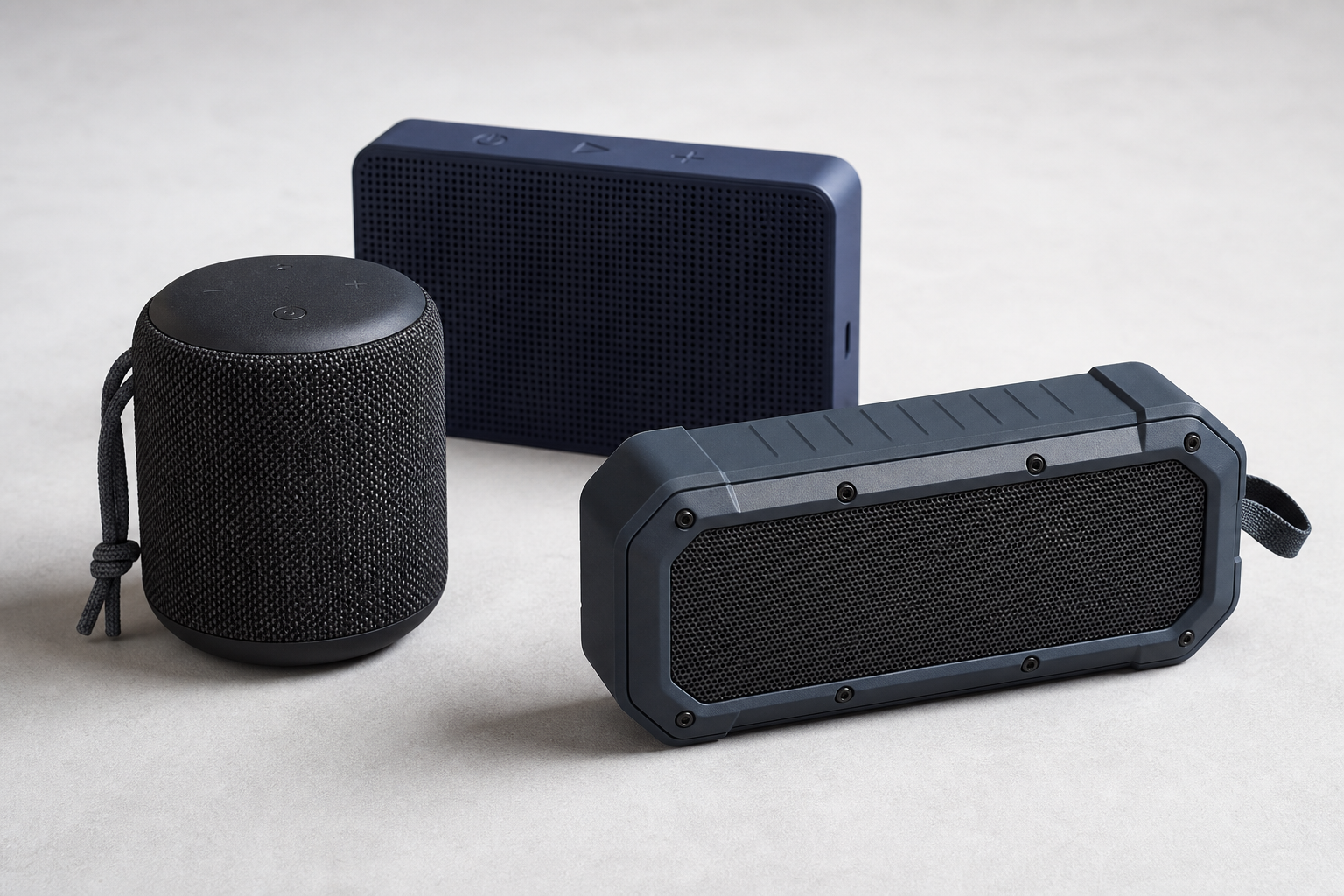
Bluetooth speakers are one of the most popular consumer electronics categories — and also one of the most confusing to shop for. Every product page promises “360-degree sound,” “deep bass,” and “20-hour battery life,” but the specs don’t always translate to real-world quality. Knowing what to actually look for makes the difference between a speaker you love and one that sits in a drawer after two weeks.
This guide walks through the main types of Bluetooth speakers, the specs that matter, the features worth paying for, and how to match a speaker to how you actually plan to use it.
The Main Types of Bluetooth Speakers
Before comparing specs, it helps to identify what form factor fits your use case. Bluetooth speakers come in several distinct categories:
Compact Portable Speakers (Under 1 lb)
These are the clip-in-your-bag, take-anywhere speakers — typically cylindrical or small rectangular designs that prioritize portability over volume. They’re designed for solo listening, desk use, or outdoor situations where you’re moving frequently. Bass is limited by physics at this size, but modern DSP tuning (digital signal processing) can partially compensate. Battery life ranges from 6–12 hours typically.
Best for: Hiking, travel, desk use, beach days where you’re moving often.
Mid-Size Portable Speakers (1–3 lbs)
This is where most of the market lives. Mid-size speakers balance portability with real audio output. They’re large enough to fill a backyard, small apartment, or group gathering. Battery life extends to 12–24 hours in many models. This category includes most of the popular waterproof outdoor speakers.
Best for: Backyard parties, camping trips, beach days, kitchen/garage use, group listening.
Large Party Speakers (3+ lbs)
Designed to fill large outdoor spaces, rooftops, or rooms. They sacrifice portability for significant output volume. Many include LED light shows, karaoke microphone inputs, and multi-speaker pairing. They’re often carried via handle rather than a bag.
Best for: Outdoor events, parties, gatherings of 10+ people, situations where volume is the priority.
Bookshelf / Home Bluetooth Speakers
These plug into the wall and prioritize sound quality over portability. They often use passive radiators, larger drivers, and dedicated amplifiers to produce audiophile-grade sound. Some include Wi-Fi for multi-room systems. They don’t have batteries but deliver significantly better audio performance for their price than portable speakers.
Best for: Home listening, office setups, stationary use where audio quality matters more than portability.
Key Specs to Evaluate
1. Driver Size and Configuration
The driver is the physical speaker element that converts electrical signal into sound. Larger drivers generally produce more bass and volume. A 40mm driver in a compact speaker and a 90mm driver in a mid-size speaker are in fundamentally different leagues. Many quality speakers use a two-driver configuration (one for mids/highs, one passive radiator or woofer for bass) which improves stereo separation and low-end response.
Watch for: Specs that don’t list driver size at all. It’s not a red flag alone, but combined with vague claims about “deep bass,” it’s worth skepticism.
2. Frequency Response
Frequency response tells you the range of audio frequencies the speaker can reproduce, measured in Hertz (Hz). Human hearing spans roughly 20Hz–20kHz. A speaker rated at 60Hz–20kHz can’t reproduce the deepest bass but covers most music well. A speaker rated at 100Hz–20kHz will sound noticeably thin on bass-heavy tracks.
Lower frequency response floor = more bass capability. For music with real bass presence (hip-hop, electronic, pop), look for a lower bound of 70Hz or lower if possible in the form factor you’re considering.
3. Total Output Wattage (RMS)
Always look for RMS wattage, not peak wattage. Peak wattage is a brief maximum that doesn’t represent real listening loudness. RMS (Root Mean Square) is the sustained output number that actually tells you how loud the speaker plays in normal use.
A 10W RMS speaker vs. a 10W peak speaker can be dramatically different in actual volume. Many budget products advertise peak numbers in large font and bury RMS in fine print — or omit it entirely. If only one number is listed without specifying RMS, treat it as suspect.
4. Battery Life
Advertised battery life is measured at 50–60% volume in controlled conditions. If you’re playing at 80–100% volume (which most people do at outdoor gatherings), expect real-world battery life to be 25–40% shorter than advertised.
For a full day at the beach: look for 20+ hours advertised. For desk use or occasional sessions: 12 hours is plenty. Also check: does the speaker support charging via USB-C? (More portable power banks support this.) Does it charge while playing?
5. Waterproofing Rating
The IP (Ingress Protection) rating tells you how well protected the speaker is against water and dust. The two most common ratings:
- IPX5: Protected against water jets from any direction. Handles rain and splashing — fine for outdoor use, not for submersion.
- IPX7: Can be submerged in 1 meter of water for 30 minutes. Pool-safe, beach-safe, survives accidental drops in water.
- IP67/IP68: Full dust protection + significant water resistance. Best for rugged outdoor use.
If you’re using the speaker anywhere near water — pool, beach, boat, shower — IPX7 or better is strongly recommended. IPX5 is fine for rain; it’s not fine for being knocked into the pool.
6. Bluetooth Version and Range
Modern speakers use Bluetooth 5.0 or higher. The advantages over older versions: longer range (up to 30 meters line-of-sight in open air vs. 10 meters for BT 4.x), lower energy consumption, and more stable connections. If a speaker advertises Bluetooth 4.2 in 2024–2025, it’s using older internals.
Also look for: multi-device pairing (can two phones stay connected so guests can take turns controlling music?) and aptX or AAC codec support (better audio streaming quality than standard SBC).
Features Worth Paying For
- Stereo pairing / TWS (True Wireless Stereo): Two of the same speaker can be paired left/right for genuine stereo separation. Massively improves the listening experience for music vs. mono playback from a single unit.
- Built-in voice assistant compatibility: Some speakers integrate with Alexa or Google Assistant for hands-free control. Convenient for kitchen or smart-home setups.
- Outdoor durability (drop resistance, dust rating): Beyond waterproofing, ruggedized models withstand physical drops and dusty environments. Worth it for camping or construction site use.
- USB-C charging: Makes it compatible with your phone charger cable — one less cable to carry.
- Aux input (3.5mm): Useful as a backup when Bluetooth drops or when connecting non-Bluetooth sources.
- Multi-room / party mode: Some ecosystems (JBL PartyBoost, Bose SimpleSync) let you sync multiple speakers across a space.
Features That Usually Don’t Matter
- LED light shows: Consume battery, add cost, rarely improve sound quality. Nice if aesthetics matter to you; skip if audio is the priority.
- “360-degree sound” marketing: This is often a marketing claim, not a technical specification. Omnidirectional output is real (cylindrical speakers achieve it) but doesn’t automatically mean better sound.
- Built-in FM radio: Rarely used by most buyers. Adds cost, doesn’t improve Bluetooth performance.
- App control: Some apps add EQ control (useful) but many just add complexity without improving audio.
Matching Speaker to Use Case
Outdoor Adventures (Hiking, Camping, Kayaking)
Priority specs: IPX7+, long battery life (20+ hours), drop resistance, compact and lightweight. Audio quality at 100% volume matters more than audio quality at 50%. The speaker will compete with wind and ambient noise, so raw volume output is important.
Home and Office Listening
Priority specs: audio quality (wider frequency response, larger drivers), stable Bluetooth connection, multi-device pairing. Waterproofing is secondary. Consider a bookshelf-style Bluetooth speaker if sound quality is important — they deliver significantly better performance than portable models at the same price.
Parties and Social Gatherings
Priority specs: high volume output (RMS wattage), battery life, stereo pairing or multi-speaker sync, durable build. A single mid-size speaker often isn’t enough for a large backyard. Two speakers in stereo mode or multiple synced units cover space much better.
Gifts and Resale
Bluetooth speakers are consistently high-velocity products in the consumer electronics resale market. Mid-size outdoor models in the $40–$120 range are popular gifts (birthdays, graduations, Father’s Day) and sell reliably through Amazon, eBay, and Facebook Marketplace. For resellers sourcing inventory at wholesale, Bluetooth speakers offer solid margins and repeat demand. Browse current electronics inventory at Velt Supply to see what’s available for wholesale or individual purchase.
Quick Comparison: Budget vs. Mid-Range vs. Premium
| Price Range | What You Get | What You Sacrifice |
|---|---|---|
| Under $50 | Portability, basic sound, decent battery | Bass depth, volume ceiling, durability |
| $50–$120 | Good all-around performance, IPX7, BT 5.0 | Audiophile-grade clarity, multi-room ecosystems |
| $120–$250 | Excellent sound, stereo pairing, rugged builds | Not much — this is the sweet spot for most buyers |
| $250+ | Premium audio quality, smart home integration, long warranties | Portability (heavier), value per dollar can diminish |
Bluetooth Speaker Buying Checklist
- ✅ Identify your primary use case (outdoor/travel, home, parties)
- ✅ Check RMS wattage — not peak wattage
- ✅ Look for IPX7 if you’ll be near water
- ✅ Confirm Bluetooth 5.0 for range and stability
- ✅ Check advertised battery life and expect 25–40% less at full volume
- ✅ Look for USB-C charging for convenience
- ✅ Verify stereo pairing support if you might buy a second unit later
- ✅ Read user reviews specifically about real-world volume and bass — not just spec sheets
Shop Electronics at Velt Supply
Whether you’re looking for a Bluetooth speaker for yourself, shopping for a gift, or sourcing consumer electronics inventory for resale, Velt Supply carries a rotating selection of in-demand tech accessories and gadgets — all shipped brand new with free nationwide shipping.
Browse the Electronics collection at Velt Supply for current inventory, or shop the full store at VeltSupply.com for deals across all categories.
Leave a Reply